In the grim darkness of the far future, there is only war
The sacraments of the Apothecary — narthecium, reductor, medi-pack, diagnostor, stasis-vial, chirurgeon-tools. Mechanicus-blessed instruments that keep the Emperor's warrior on the line, recover the progenoid of the fallen, and grant the Emperor's Mercy when the wound is already prayer.
Contents
Contents
Contents
Contents
The Sacraments of the Apothecary
The medical equipment of the Empire is not the equipment of healing alone. It is the equipment of triage, of recovery, of the sacred duty to keep the Emperor of Mankind's soldier on the line for one more hour, one more day, one more campaign — and when that soldier can be kept on the line no longer, it is the equipment of the Mercy that closes his eyes with the dignity that ten thousand years of doctrine demands. The narthecium and the medi-pack are not tools but sacraments; the men who wield them are not technicians but priests-surgeons whose hands move through rites that the Adeptus Mechanicus codified centuries before the Heresy and the Ecclesiarchy refined in the millennia after.
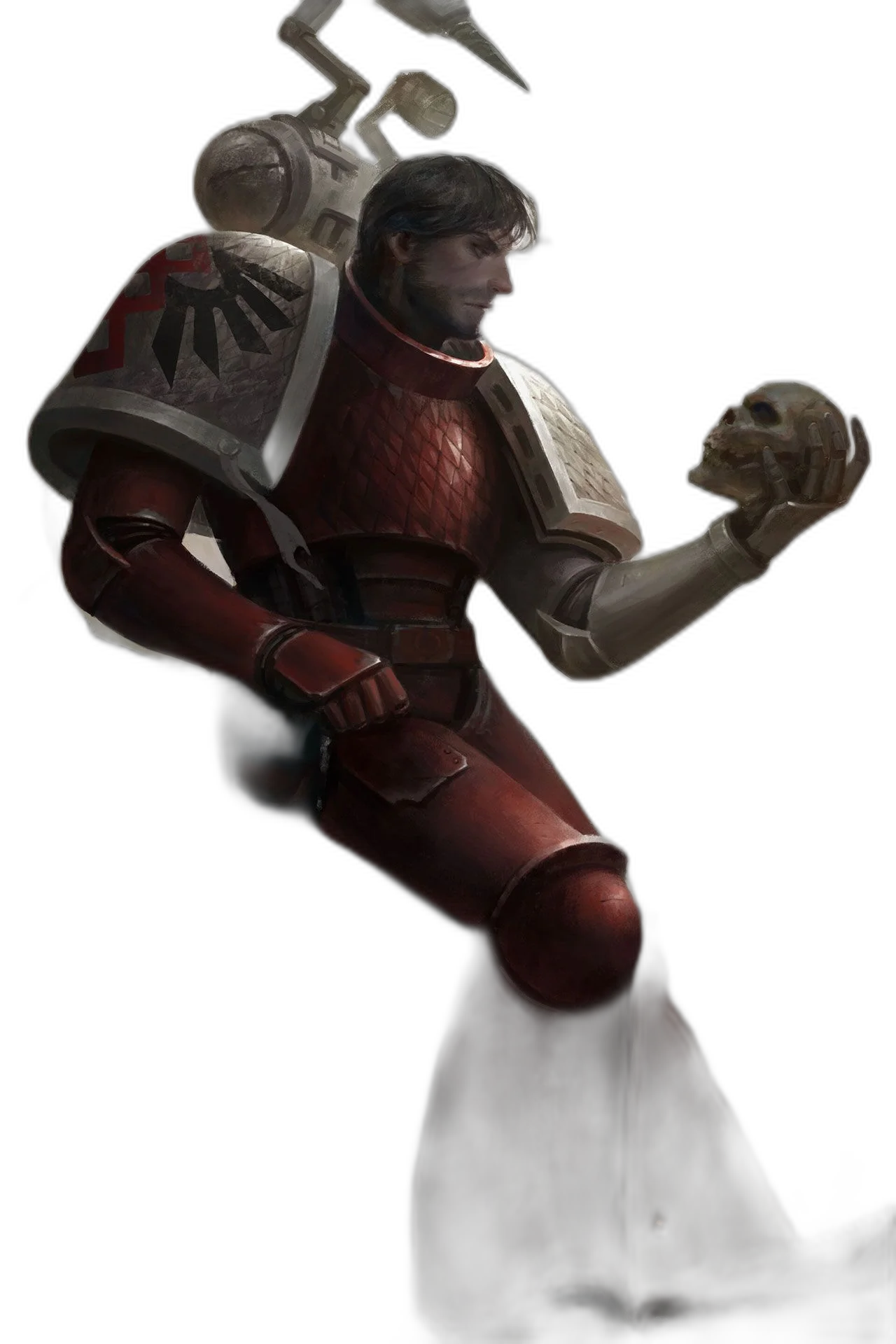
The sacraments of the Apothecary span chapel infirmary, battlefield triage and reliquary vault — every wounded brother sheltered beneath the Aquila is sacred ground.
Imperial field medicine operates at two stratified tiers. The Apothecary — exclusive to the Adeptus Astartes, to the Sanguinary Guard of the Blood Angels lineage, and to a small handful of equivalent specialised orders — is the priest-surgeon of the gene-seed, custodian of the progenoid recovery and of the most theologically loaded medical operations in the Imperial military. Below the Apothecary stands the Medicae — the field-surgeon of the Astra Militarum regiment, of Inquisitorial Acolyte cells, of the regimental Schola Progenium chapels — who tends the bulk of Imperial wounded with simpler equipment and broader doctrine. The two tiers operate in parallel and, where possible, in coordination; the Astartes Apothecary will not perform medi-pack triage on a Astra Militarum line trooper unless circumstances demand, and the Medicae will not perform progenoid recovery on a fallen Astartes — that is the Apothecary's exclusive sacrament, and the Medicae's hand on the reductor would be heresy.
The strategic significance of medical equipment in Imperial doctrine cannot be overstated. A Chapter without functional Apothecaries cannot recover progenoid, cannot reseed its gene-line, and goes extinct within one to two centuries — every great Astartes catastrophe in Imperial history has been measured in part by the number of Apothecaries lost and the consequent inability of the Chapter to recover. The Medicae of the Astra Militarum perform similarly load-bearing work at the level of the regiment: a regiment that cannot triage and stabilise its wounded loses men at rates that compound over the course of a long campaign, until the unit becomes operationally non-viable. Medical equipment is therefore not optional but fundamental to the long-term sustainability of Imperial fighting strength.
Coordinating institutions weave the two tiers together at the Imperium-wide scale. The Medicae Imperialis — the doctrinal organisation that governs all non-Astartes Imperial medical practice — establishes cross-faction protocols for triage priority, evacuation procedure, and gene-seed handling in mixed-formation operations. When Astartes and Astra Militarum forces operate together, the Medicae Imperialis protocols ensure that the rare Apothecary's time is not wasted on guardsmen-grade wounds while a Medicae's hand is denied access to a stabilising procedure that would save an Astartes life. The protocols are dense, theologically loaded, and not always followed with full doctrinal rigour in the chaos of active combat — but their existence shapes the practical experience of Imperial medical operation across every joint formation.
Limits of Imperial medical doctrine are honestly catalogued in the standard texts. Psychic wounds — the kind inflicted by Chaos sorcerers, by Warp-tainted weapons, by daemon-possession-in-progress — cannot be healed by narthecium or medi-pack; they require the psy-medicae specialist or the astropath surgeon, both of whom serve in dedicated roles outside the standard Apothecarion hierarchy. Chaos taint, once it has progressed beyond simple physical injury, requires Chaplain or Confessor purgation rather than medical healing — the affected limb is removed, the wound cauterised, and the soldier is either restored or, if the taint has reached too deeply, granted the Mercy. Daemon possession in any stage requires the Inquisitor and his exorcism rites; the Apothecary will not attempt to medicate a possessed body, and to do so would be doctrinal failure of the gravest kind.
The Apothecarion Lineage
Imperial medical equipment traces its origin to the same Dark Age of Technology foundations that produced the Imperium's other STC-derived war material. The earliest narthecium patterns now in service descend from regenerative-medicine cogitator templates recovered Mars-side in the centuries before the Great Crusade, when the early Mechanicum priesthood reconstructed working medical-cogitator systems from fragmentary data preserved on a handful of forge-worlds that had outlasted the Age of Strife. The reductor — the progenoid-recovery drill that defines the Apothecary's distinct ministry — was reconstructed in the same era, its mechanism deduced from anatomical-cogitator templates that the Mechanicum had been holding for centuries before they fully understood what the cogitator's surgery-routines were intended to extract.
The Apothecarion lineage is older than the Imperium remembers — every cleric inherits a vault, a vow, and the chain of progenoid stretching back to the Heresy.
The Great Crusade saw the codification of Astartes medical practice as a distinct discipline within Imperial medical science. Each of the original Legions developed an Apothecary corps with subtle pattern-variations — the Apothecary of the Ultramarines favoured a slightly larger narthecium with extended fluid-reservoirs; the Apothecary of the Blood Angels developed pattern-variations specifically suited to the lineage's blood-flaw demands; other Legions evolved their own preferences within the broad framework of Mechanicus-sanctioned narthecium design. By the close of the Crusade, the Apothecary as institution had been standardised across all Legions, with the Adeptus Mechanicus producing a unified family of narthecium patterns that all Astartes Apothecaries would recognise even when minor variations distinguished one Legion's Apothecarion from another's.
The Horus Heresy inflicted devastating losses on the Apothecary corps and on the lineages they sustained. Traitor Apothecaries, possessing the same equipment as loyal counterparts, abused the gene-seed they recovered from fallen brothers — corrupting the progenoid, twisting the seed-line, sowing the gene-bearing material that would in subsequent millennia produce the Heresy-corrupted Chaos Astartes formations that loyal Imperial forces continue to face today. After the Heresy, the Apothecary corps was reformed under stricter Mechanicus oversight; gene-seed handling protocols were rewritten with multiple redundant verifications; and the Apothecary's narthecium itself was redesigned to incorporate self-destruct mechanisms that would render gene-seed unrecoverable in event of capture. These redesigns, completed across the long centuries of the Age of Imperial Restoration, established the narthecium pattern that has remained essentially stable across the millennia since.
The post-Heresy centuries also saw the rise of the Sanguinary Priest tradition within the Blood Angels lineage and its successor Chapters — a specialised variant of the Apothecary role that integrates blood-related ritual and Sanguinary doctrine into the standard Apothecary's medical practice. The Sanguinary Priest's narthecium incorporates additional blood-stasis vials and ritual implements specific to the lineage's needs, and the Sanguinary Guard honour-formation maintains its own distinct apothecarion within the Chapter. Equivalent lineage-specialised variants exist within the Ultramarines and several other Founding Chapters, though none has the institutional prominence of the Sanguinary Priest tradition. Each variant is treated by the Adeptus Mechanicus as a sanctioned divergence from the standard pattern rather than as a heretical innovation.
The Indomitus Era brought the most significant refinement of Apothecary equipment in living memory. Belisarius Cawl's tech-magos collaborators, working under the resurrected Roboute Guilliman's direct mandate, produced the Mark IV narthecium specifically optimised for Primaris compatibility — Primaris geneseed yields are different from standard Astartes geneseed, and the Mark IV reductor incorporates extraction routines tuned to the new physiology. The Mark IV narthecium also addresses long-standing limits of the Mark III pattern, particularly in fluid-reservoir capacity and in the stim-injection sequencing that defines acute trauma response. Indomitus-Era Apothecaries fielding the Mark IV report measurable improvements in field-surgery success rates compared with their Mark III experience, and the Adeptus Mechanicus has formally sanctioned the new pattern for general Astartes issue across all Founding Chapters that operate Primaris formations.
Throughout this long history, the Adeptus Mechanicus has maintained a custodial monopoly on narthecium and reductor manufacture. No Imperial institution outside the Mechanicus is permitted to design, fabricate, or fundamentally alter Astartes medical equipment, and the consequences of unauthorised manufacture would be technological heresy of the highest grade. The Mechanicus monopoly extends, in attenuated form, to Medicae equipment as well — the medi-pack, the diagnostor, and the chirurgeon-tools used by the Astra Militarum are similarly Mechanicus-sanctioned, though their production at scale across forge-worlds means the doctrinal control is less personal than for the rare Astartes-grade equipment.
Narthecium
The narthecium is the signature instrument of the Adeptus Astartes Apothecary — a chirurgical gauntlet integrating reductor, auto-injectors, scalpel array, fluid reservoirs, and a battery of sub-cogitator systems into a single armoured glove that fits over the Apothecary's standard power-armour gauntlet. Activated through cogitator command, the narthecium can perform triage scan, emergency injection of stim or pain-suppress or coagulant, on-the-spot field surgery, and progenoid extraction (via its integrated reductor sub-tool, treated separately in the next section). Every sacrament of Astartes field medicine flows from the narthecium; without it, the Apothecary is merely a power-armoured warrior with surgical training.
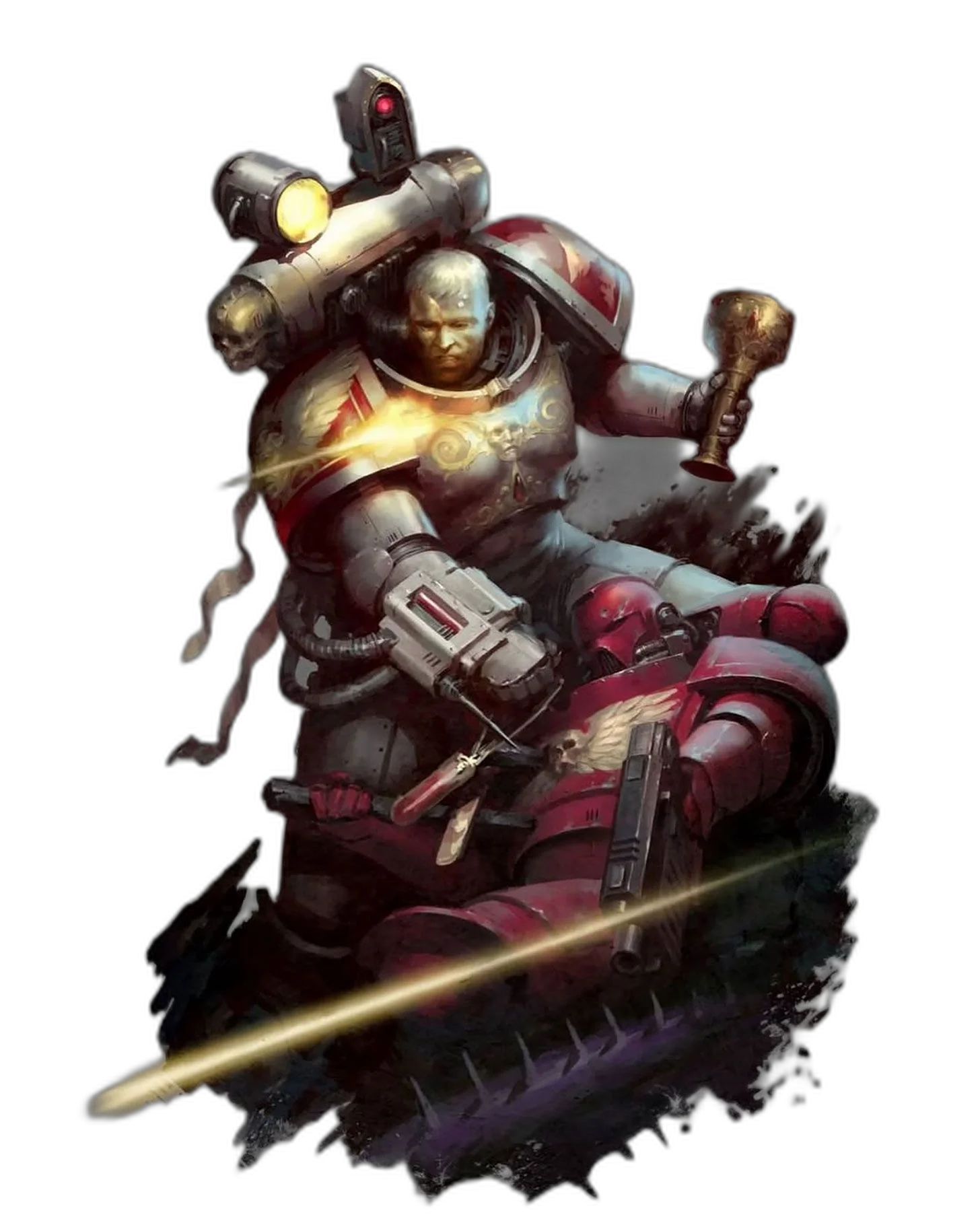
The narthecium is the gauntlet that grants Mercy and reclaims the progenoid — every gesture between life and the next generation passes through its anointed mechanisms.
Standard pattern narthecium devices are forearm-and-hand assemblies, weighing approximately fifteen kilograms when fully fluid-loaded, integrated with the Apothecary's armour at the shoulder via a power-feed and data-cable that draws from the armour's main systems. The cogitator-spirit within is sophisticated enough to identify wounds at species-specific resolution, recommend triage priority, sequence injections appropriately, and warn the Apothecary if a wound exceeds the narthecium's recoverability threshold. Operation requires extensive training that the Adeptus Mechanicus supervises directly — a candidate Apothecary serves a multi-decade apprenticeship before being permitted to wear the narthecium without supervision, and the proper litanies for cogitator-spirit address must be memorised across hundreds of distinct operational contexts.
Master-Crafted variants exist for senior Apothecaries within specific lineages. The Sanguinary Guard pattern, exclusive to the Blood Angels and their successors, incorporates additional blood-stasis vials and Sanguinary ritual elements that integrate the narthecium's medical function with the lineage's blood-related doctrines. Primaris Mk.IV narthecium devices, deployed across Indomitus Crusade Apothecaries, offer improved gene-seed yield through extraction routines specifically tuned to Primaris physiology and a fluid-reservoir capacity expanded beyond Mark III limits. Other Founding Chapters maintain their own subtle narthecium variants, sanctioned by the Adeptus Mechanicus and treated as appropriate divergence from the universal pattern rather than as competing patterns.
Reverence for the narthecium permeates every aspect of Apothecary practice. Each device is named at activation; each is assigned a service-history that follows it through every operational tour; each is blessed by the Adeptus Mechanicus enginseer attached to the Apothecarion before deployment. Apothecaries pray over their narthecium before every engagement, recite litanies of healing and Mercy as part of the activation sequence, and treat the device with a reverence that the secular Imperial military observer would find startling in its intensity. The narthecium is not equipment to be optimised but a relic to be venerated — and in the Apothecary's hand, its function is inseparable from its sanctity.
The risk profile of a captured narthecium is among the most catastrophic in the Imperial inventory. The device contains gene-seed signatures specific to its operating Apothecary's Chapter; its cogitator-spirit holds the working knowledge of the Apothecary's recent operations and the gene-seed yields of those operations; its sub-cogitator systems are theologically calibrated in ways that yield significant intelligence about the Chapter's apothecarion practices. A captured narthecium falling into Chaos hands would yield gene-seed corruption pathways the Heretics could exploit for centuries. Imperial doctrine therefore mandates self-destruct: every narthecium incorporates a small-charge mechanism that the Apothecary triggers before death or capture, rendering the device's contents — both physical and informational — unrecoverable. The protocol is taught in Apothecary novitiate training and is, by long doctrinal practice, executed without hesitation when circumstances demand.
Beyond the standard medical functions, the narthecium serves the Mercy doctrine — the practice by which an Apothecary administers a lethal injection to a brother whose wounds are unrecoverable, granting the Emperor of Mankind's Mercy as a final sacrament. Astartes accept the Mercy without reservation; refusal of the offered Mercy is heresy of the lesser sort, judged as evidence of corrupted faith or incomplete spiritual discipline. The Apothecary trained to administer the Mercy carries the procedure in his muscle memory alongside the procedures of healing — a single act, executed with the same instrument, in service of the same sacred duty: to keep the brother on the line for as long as possible, and when no longer possible, to grant him the dignity of an Astartes death.
Reductor
The reductor is the most theologically loaded instrument in the Imperial medical inventory — a sub-tool of the narthecium, sometimes carried as a standalone device, dedicated specifically to extraction of the progenoid gland from the chest cavity of fallen Adeptus Astartes. Where the narthecium broadly serves the living, the reductor serves the dead — and through the dead, the future of the Chapter that mourns them. To wield the reductor is to perform a sacrament that exists in no other Imperial military role; it is the one instrument whose proper use sustains the Astartes lineage across millennia.
The reductor extracts the progenoid before flesh becomes silence — gene-seed reclaimed for the next generation of war.
The progenoid gland — also called the gene-seed — is the embedded reproductive material that allows a Chapter to seed new Astartes from young initiates. Implanted during Astartes induction and slowly maturing over years of service, the progenoid is recoverable from the fallen Astartes for a period of approximately seven days post-death, after which the gene-bearing material degrades beyond useful retrieval. The reductor's function is to extract this material before the seven-day window closes, sealing it in a stasis-vial (treated in section 7) for transport back to the Chapter's apothecarion vault and eventual implantation in a new generation of recruits. Without successful reductor use, the lineage dies with the Astartes.
The reductor is restricted by Imperial doctrine to Apothecary use only. No other Imperial soldier — no Captain, no Chapter Master, no Inquisitor, no Astra Militarum Medicae — may operate the reductor. The restriction is theological as much as practical: the gene-seed is sacred Astartes property, and only the Apothecary trained in the proper rites is permitted to extract it. A non-Apothecary who attempts reductor extraction commits doctrinal heresy, and the gene-seed produced by such an extraction is considered tainted regardless of its physical condition. This restriction is enforced even in extreme circumstances; the Chapter Master who would attempt reductor extraction with his own hand from a dying brother to whom he was personally bonded would, by long-codified doctrine, be expected to refrain even at the cost of losing the gene-seed entirely.
The ritual of progenoid extraction is among the most extensively codified in Apothecary doctrine. Before extraction, the Apothecary recites the litany-of-stewardship — a brief prayer acknowledging the brother's service and committing the gene-seed to its future. During extraction, the Apothecary maintains a controlled litany-of-recovery that addresses both the cogitator-spirit of the reductor and the spirit of the fallen brother. After extraction, the gene-seed is sealed in a stasis-vial with a final litany-of-passage, and the vial is marked with the brother's identifying sigil before transport. The procedure takes approximately eight minutes when uninterrupted; in active combat, where interruption is the rule rather than the exception, an Apothecary may abandon a partial extraction and return to the body later if seven-day window permits, or accept the loss of the gene-seed if circumstances forbid return.
Limits of the reductor are honestly catalogued in Apothecary training texts. Extraction beyond the seven-day post-death window yields gene-seed corrupted by autolytic degradation; the cogitator-spirit will warn the Apothecary if the window has effectively closed, and the procedure is abandoned if so. Combat conditions may force the Apothecary to abandon both body and gene-seed — the institutional pain of such loss is real and the Apothecary will be debriefed on the circumstances by the Chapter Master, but the doctrinal expectation is that the Apothecary makes the call honestly when extraction would cost more lives than the gene-seed represents. Chaos-tainted bodies must not have their gene-seed extracted at all; the seed of a Chaos-touched brother is considered corrupted from the moment of taint, and the body is destroyed by Chaplain rather than processed by Apothecary.
Lost reductor variants existed in pre-Horus Heresy Apothecary kits — Heresy-era reductor patterns incorporating cryogenic on-board storage, eliminating the need for an external stasis-vial during extraction. Modern reductor patterns require the external stasis-vial because the post-Heresy redesign stripped out the cryogenic-storage capability — a deliberate doctrinal choice favouring smaller, more easily destroyed devices over more capable but more dangerous ones. The choice was made in the centuries of the Age of Imperial Restoration on grounds that have been debated by the Adeptus Mechanicus ever since; the practical consequence is that a fallen Astartes' gene-seed can only be recovered if the Apothecary has stasis-vials in his kit, which constrains the operational tempo of progenoid recovery in long campaigns.
Medi-pack
The medi-pack is the standard general-issue medical kit of the Astra Militarum — backpack-sized for the regimental Medicae specialist, smaller for officer-issue, designed to keep individual soldiers stabilised long enough for proper evacuation to apothecarion-grade facilities. Where the narthecium serves the rare Astartes Apothecary, the medi-pack serves the broader Imperial fighting force: every Imperial Guard regiment, every Inquisitorial Acolyte cell, every Ecclesiarchy field-confessor's entourage, every PDF unit of any size carries some quantity of medi-pack equipment, distributed among the Medicae and officer cadre according to standard Departmento procedure.
The medi-pack carries the field-sacraments of triage — bandage roll, stim-dose, and the mercy of the Emperor between life and the cold dark.
Standard pattern medi-packs contain bandages, coagulants, stimulants, pain-suppressors, auto-injector cartridges, splints, cauterizers, cleansing solvents, and a small selection of broad-spectrum antibiotics — the entire toolkit needed to stabilise common combat wounds long enough for evacuation. The Medicae carrying the pack will not, in standard doctrine, attempt full field surgery; the medi-pack is not designed for surgery, and a Medicae who attempts surgery using only medi-pack contents is operating outside doctrinal scope. Stabilisation, evacuation triage, and the rare emergency intervention when an Apothecary or surgeon is unreachable — these are the medi-pack's domain. The Medicae's job is to keep the wounded soldier alive long enough for someone better-equipped to save him.
Range and capacity vary by pattern. A standard backpack medi-pack is mission-rated at 24-72 hours and three to five wounded soldiers per pack before resupply, depending on wound severity; an officer-issue pack is smaller and serves only the officer himself plus perhaps one nearby casualty before exhaustion. Long-campaign conditions stress the supply chain — Imperial regiments operating in protracted warzones often run their medi-pack stocks below sustainable levels for weeks at a time, and Medicae are forced to ration coagulants and stimulants in ways that the standard doctrine would not permit. The casualty rates of supply-stressed regiments rise correspondingly; medi-pack adequacy is, by Departmento Munitorum measurement, one of the most reliable predictors of regimental survival in long campaigns.
Regimental variants exist across the Astra Militarum's diverse fighting traditions. The Cadian pattern medi-pack is rated for frostbite and thermal-burn handling, optimised for the cold-weather warfare typical of Cadia's home conditions and the void-translation environments where Cadian regiments often deployed; the Catachan Jungle Fighters pattern is heavy with anti-venom and toxin-counter agents, reflecting the death-world environments where Catachan regiments are renowned for their adaptation; the Death Korps of Krieg pattern incorporates additional gas-warfare and chemical-weapon counter-measures, reflecting the Death Korps' doctrinal commitment to operations in the most contaminated environments the Imperium fields its forces against. These variants are not interchangeable in the strict sense, but the standard pattern remains the universal baseline that any Medicae of any regiment can operate.
Wielders of the medi-pack span every level of Imperial non-Astartes military hierarchy. The regimental Medicae specialist — typically a soldier with extended training at his regiment's Schola Progenium equivalent — carries the largest pack and serves the platoon-and-above scale. Imperial officers typically carry smaller medi-packs as personal kit, used for immediate self-care and for quick stabilisation of nearby casualties before the Medicae arrives. Inquisitorial Acolytes carry their own pattern variants, often with additional clandestine-operation supplies. PDF units in the late stages of system-defence campaigns may have medi-packs distributed across the entire formation as desperation drives down the supply availability of Medicae specialists.
Improvisation in long campaigns transforms medi-pack practice in ways the standard doctrine acknowledges but does not fully condone. Munitorum-issue supplies replaced by scavenged equivalents, antibiotics rationed below recommended dosages, bandages reused beyond sterile limits, coagulants synthesised by regimental enginseers from whatever local materials can be processed — all of these are documented practices of long-campaign Imperial medical operation. The doctrinal preference is for proper supply maintenance; the operational reality is that Imperial medical doctrine works around scarcity as often as it works with abundance, and the Medicae who can keep his unit functional with improvised materials is doctrinally celebrated even when his methods would not pass Schola Progenium inspection.
Diagnostor
The diagnostor is the helm-integrated bio-scanner exclusive to Adeptus Astartes Apothecary armour — a multispectral medical sensoria-cluster mounted in the helm and feeding real-time bio-data to the Apothecary's tactical overlay. Where the auspex sweeps for tactical signatures and the narthecium operates on the body itself, the diagnostor sits between them: continuously monitoring the vital signs of every Astartes within line-of-sight, identifying wound severity at a glance, flagging poison or infection or psy-trauma as it manifests, and providing the Apothecary with the situational awareness needed to triage a battlefield casualty list before he reaches the wounded.
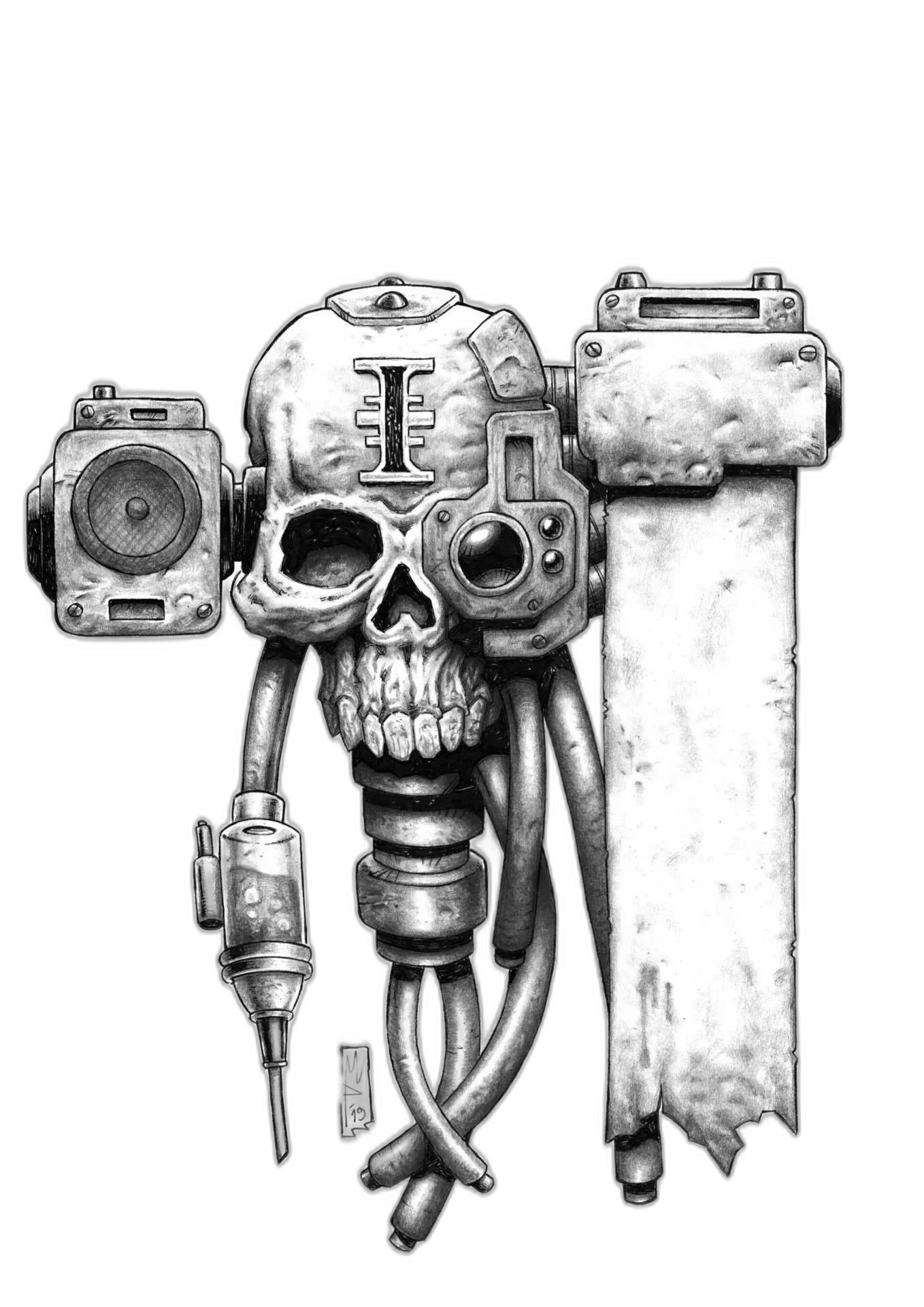
The diagnostor scrying flesh for the wound's true name — auspex-eye, blood-probe, vital ribbon trailing the gene-seed's last whisper.
Standard diagnostor patterns operate at line-of-sight ranges of approximately thirty metres, with operational range degrading substantially in heavy electromagnetic interference or in conditions of Warp-bleed where the Astartes vital-signature data becomes unreliable. The cogitator-spirit within the diagnostor parses the bio-feed in real time, presenting the Apothecary with prioritised triage information — which Astartes is most critically wounded, which is approaching the recoverability threshold, which can wait. This computational triage is doctrinally critical: in any major Astartes engagement, the Apothecary may face a dozen casualties simultaneously, and the human eye cannot resolve which to attend first as accurately as the diagnostor's cogitator-spirit can.
Mechanicus rites for the diagnostor are extensive and exacting. The cogitator-spirit must be blessed at activation by an enginseer, with calibration verified after every void-translation; the bio-signature templates must be refreshed periodically as the Chapter's gene-line characteristics evolve through generational drift; and the helm-integration assembly must be ritually verified after every armour-maintenance cycle to ensure that the diagnostor's data-flow remains uncorrupted by armour-spirit interference. Apothecaries are taught to recite specific litanies when activating the diagnostor at the start of an engagement, and again when shutting it down at the conclusion — the cogitator-spirit, by Mechanicus theology, is not a passive instrument but an active participant in the medical sacrament.
Limits of the diagnostor are honest and rehearsed. The device can identify Chaos taint — the bio-signature changes characteristic of corrupted Astartes physiology — but it cannot cleanse the taint, only flag the affected brother for Chaplain or Apothecary intervention. The diagnostor can identify Daemon-possession-in-progress through its bio-signature anomaly recognition, but again it can only flag, not exorcise; the affected brother is referred to the Chaplain immediately, with the Apothecary refraining from medical intervention on grounds that medication of a possessed body is doctrinal failure. Psy-trauma — the wounds inflicted by enemy psyker-attacks or by the brother's own psychic exposure — falls within diagnostor detection but exceeds standard Apothecary treatment scope; the brother is stabilised physically and referred to the Chapter's Librarius or to Astropath specialists for full recovery.
The Primaris Mk.IV diagnostor, deployed across Indomitus Crusade Apothecaries, addresses two specific weaknesses of the Mk.III pattern: extended psy-trauma identification subroutines that resolve more granular categories of psychic wound than the older pattern could, and improved Warp-bleed filtering that maintains diagnostor coherence in Chaos-tainted environments. Apothecaries who have fielded both patterns report that the Mk.IV functions in conditions where the Mk.III simply ceases to provide reliable data — a substantial operational improvement, even though the underlying medical doctrine remains essentially identical between the two patterns. The Mk.IV is not yet universal Astartes issue but is reaching widening Primaris formations across the Indomitus Crusade.
Stasis-Vial
The stasis-vial is the cryogenic preservation flask that holds extracted progenoid until it can be transported to the Chapter's apothecarion vault — a small armoured cylinder, roughly the size of a clenched fist, capable of suspending its biological contents at -120°C internal cryo-temperature for periods extending well beyond standard operational tour durations. Each stasis-vial carries one progenoid; an Adeptus Astartes Apothecary deploying with a strike force is standard-issued six vials, with the expectation that any individual operation may produce more recovered gene-seed than vials available, in which case the surplus is lost and the institutional grief is recorded.
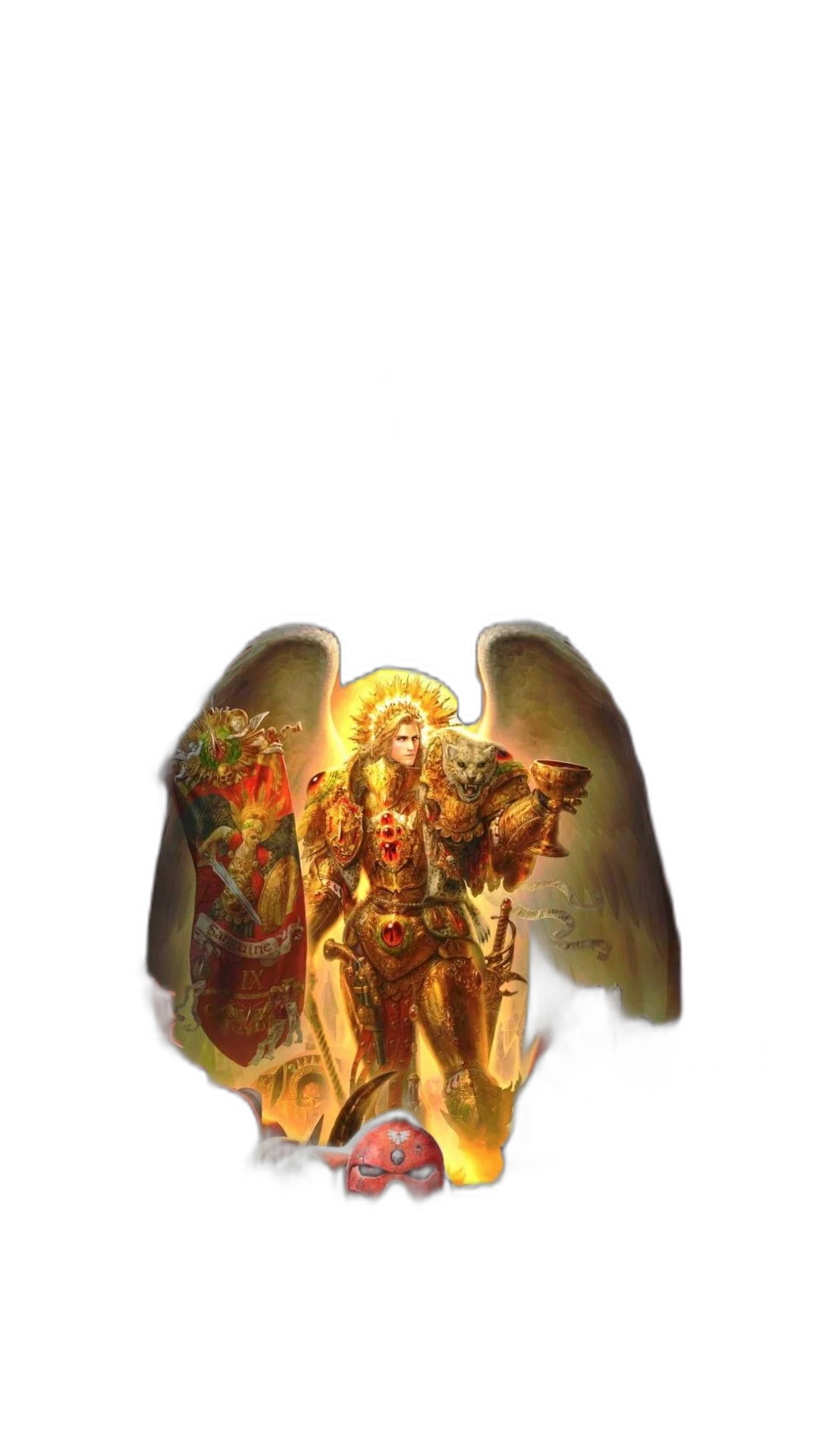
The Sanguinary Chalice cradles the gene-seed legacy of Sanguinius — every drop preserved is the future of every Blood Angels son to come.
The reverence with which stasis-vials are treated reflects their burden. Each vial, once filled, is sealed with the identifying sigil of the brother whose gene-seed it carries; the Apothecary recites a litany-of-passage as he completes the seal, committing the future Astartes that this gene-seed represents to the Chapter's care. The vial is then carried with extreme deliberation through the remainder of the operation — the Apothecary will, by long doctrine, expose his own life to greater risk to protect the vial than he would to protect his own narthecium, because the narthecium is replaceable and the gene-seed is not. Loss of a stasis-vial in active combat — through dropping, through enemy fire, through the Apothecary's own death before he could secure transport — is wept over and atoned for during the post-engagement debrief, and a sergeant-grade pastoral inquiry follows.
Operational limits of the stasis-vial are exacting. The internal power cell that maintains the cryogenic suspension lasts approximately thirty days standalone; beyond that interval, the vial requires recharge at a Chapter forge or apothecarion facility. Field-recharge through the Apothecary's narthecium-armour power-feed is possible but doctrinally discouraged — every recharge cycle from a non-forge source slightly degrades the long-term reliability of the vial's cryogenic stability, and the Adeptus Mechanicus enginseer attached to the Apothecarion will note such recharges in the vial's service-history. A vial that has accumulated more than three field-recharge cycles in its operational lifetime is considered unsuitable for long-term gene-seed storage and is retired from front-line service.
Warp-translation degrades stasis-vial reliability in ways the Adeptus Mechanicus has documented but does not fully understand. Long inter-system jumps — the kind required to bring a recovered progenoid back from a deep-strike operation to the Chapter's home world — stress the cryogenic stability and may corrupt the gene-seed within if the vial's power cell falters during the warp-passage. For this reason, Astartes Strike Cruisers maintain dedicated apothecarion vaults — chambers equipped with multiple parallel stasis-vault systems whose redundant cryogenic power supply ensures survival of recovered gene-seed during the warp-translation home. An Apothecary deploying without strike-cruiser support in a particularly long campaign accepts the elevated risk that some recovered progenoid may not survive the trip back; the Chapter Master approves such missions only when the strategic value justifies the risk.
Specialist stasis-vials exist at the margins of standard Apothecary issue. The Sanguinary Guard pattern, used by Blood Angels and successor Chapters, incorporates additional blood-stasis chambers alongside the standard progenoid-suspension assembly, allowing the vial to carry both gene-seed and blood-relic samples for the lineage's specific Sanguinary protocols. Heresy-era stasis-vial patterns offered substantially longer power-cell duration than modern vials — sixty-day rated rather than thirty-day — but those patterns were lost in the Heresy and the modern manufacture cannot reproduce the longer-duration designs. The shorter-duration of modern vials is one of many small ways in which the post-Heresy Imperium operates with degraded technology compared to its pre-Heresy capability, and one which has direct casualty cost in the operational tempo of Apothecary practice.
Chirurgeon-Tools
The chirurgeon-tools are the specialised surgical instruments that lie outside narthecium scope — bone-saws, auto-sutures, osmotic flushes, exotic-extractors, gene-seed tomography drills, daemonculaba-extraction loops, and the larger family of implements used in apothecarion-grade or field-hospital-grade settings rather than in front-line battlefield medicine. The narthecium is for the line; the chirurgeon-tools are for the apothecarion. An Apothecary in active combat carries his narthecium and, in his secondary kit, a small selection of chirurgeon-tools for circumstances that exceed narthecium scope; the broader chirurgeon-tools array remains in the apothecarion vault for use when the casualty is brought to the surgeon rather than the surgeon to the casualty.
The chirurgeon's instruments wait on draped linen — each scalpel and saw a sacrament of devotion turned to flesh and bone.
Field-hospital and apothecarion deployments carry the full chirurgeon-tools array. Astra Militarum field hospitals, Adeptus Astartes Strike Cruiser apothecarions, Adepta Sororitas Hospitaller chapter-houses, and Inquisitorial xenos-research compounds all maintain dedicated chirurgeon-tools sets for the surgeons who staff them. The composition of any specific kit varies with the operational role of the facility — a Strike Cruiser apothecarion's chirurgeon-tools include extensive gene-seed-handling instruments that an Astra Militarum field hospital would never need; a Hospitaller chapter-house carries Sororitas-specific implements for the lineage's particular medical traditions; an Inquisitorial compound may carry exotic-extractors designed for xenos-tissue handling that no other Imperial institution would countenance.
Specialised tools within the broader array address specific operational challenges. The gene-seed tomography drill provides high-resolution scanning of progenoid tissue for diagnostic purposes — used in apothecarion settings to verify gene-seed integrity before the seed is committed to long-term storage or implantation in a recruit. The daemonculaba-extraction loop, an Inquisitorial-grade instrument, exists for the rare and grim circumstance of recovering Imperial subjects from daemonculaba imprisonment — a horrific Chaos-tainted operation whose details are protected at high Inquisitorial clearance. The Mechanicus reverse-augur is used for medical examination of subjects with extensive cybernetic augmentation, where standard auspex-medical scanning cannot resolve the tissue-cybernetic interface accurately. Each specialised tool is hand-forged by Tech-priest with lore-specific litanies appropriate to its function.
The manufacture of chirurgeon-tools is the exclusive prerogative of the Adeptus Mechanicus, with each instrument hand-built in forge-cathedral apothecarion-furnaces under specific Mechanicus rites. The ironwork of a chirurgeon-tool is consecrated before fabrication begins; the cogitator-spirit (where applicable) is bound during forging; the hilt or grip is wrapped in sacred materials before final assembly. A chirurgeon-tool that has not undergone full Mechanicus consecration is, by Mechanicus theology, not a true instrument but a profane fabrication — and any apothecarion or field-hospital that uses unsanctified chirurgeon-tools commits doctrinal failure of significance, even if the practical medical outcomes are indistinguishable from sanctified-tool use.
Apothecary mastery of chirurgeon-tools follows a structured progression. Junior Apothecaries train first on medi-pack equipment alongside Medicae cadres, learning the broad principles of triage and stabilisation. Mid-career Apothecaries are introduced to the narthecium and to a basic subset of chirurgeon-tools — bone-saw, auto-suture, basic flush — that they can carry as field-secondary kit. Senior Apothecaries, after decades of service, gain access to the full chirurgeon-tools array maintained in the Chapter apothecarion vault, including the more specialised instruments. The most senior Apothecaries — Chief Apothecary equivalents — are entrusted with the gene-seed tomography drill and similar high-stakes instruments, with the full theological responsibility that handling such tools entails.
Mercy, Progenoid, and Duty
Triage doctrine in mixed-formation operations places Adeptus Astartes casualties above Astra Militarum casualties in the cold calculus of Imperial war. A wounded Astartes whose gene-seed can be recovered, or whose injury is recoverable to active service, is institutionally more valuable than a wounded Guardsman of equivalent injury — not because the Guardsman is unworthy, but because the Astartes represents irreplaceable lineage capital while the Guardsman is replaceable through standard regimental recruitment. This priority is dispiriting to observe but doctrinally clear, and Chaplains attached to mixed formations intervene when the priority is disputed in the field, applying the spiritual authority of their office to enforce the doctrine without sentiment. The Guardsman who dies because the Apothecary chose the Astartes was not failed by the Apothecary — he was correctly subordinated to the strategic logic of Imperial war.
The Apothecarion sacrament — censers swing, attendants kneel, and a fallen helm waits at the master's feet; the kindest violence already done, only the gene-seed remains.
The Mercy doctrine — the practice by which an Apothecary administers a lethal injection to a brother whose wounds are unrecoverable — is among the most theologically loaded practices in Imperial medicine. The Astartes who has been judged by his Apothecary to be beyond recovery accepts the Mercy as a final sacrament; refusal would be heresy of the lesser sort, evidence of corrupted faith. The brother offered the Mercy may speak a final litany or salute, may name his Chapter or his primarch, may simply nod his acceptance — these are the canonical responses, and the Apothecary executes the procedure with the same instrument and the same litany he would have used to heal had healing been possible. The Mercy is not euthanasia in the secular sense; it is sacrament, and the brother who receives it dies in the Emperor of Mankind's grace.
Progenoid sanctity governs every aspect of post-mortem Astartes handling. The fallen brother's gene-seed is recovered first; the body is then either destroyed in place (when Chaos taint or daemon-corruption are factors) or recovered for proper rites (when circumstances permit). In retreat conditions, where the body cannot be recovered, the gene-seed must still be recovered — the Apothecary will, by long doctrine, expose his own life and even the lives of nearby brothers to recover progenoid in conditions where the body itself must be left for the enemy. This calculus is institutional, not personal; the Apothecary who would refuse such risk would be removed from his role and the Chapter would record his moral failure.
Cross-faction protocols between Astartes and Astra Militarum medical operations are codified in the Medicae Imperialis manuals that govern joint formations. The signum-handshake equivalent in medical doctrine is the apothecary-to-medicae briefing — a brief verbal exchange at the start of joint operations in which the Apothecary informs the Medicae of the Astartes triage priorities, the Mercy authorisation status, and the gene-seed recovery procedures that will apply if Astartes casualties occur. The Medicae acknowledges the briefing and adjusts his own triage protocols accordingly; the Apothecary in turn confirms his understanding of the Medicae's authority over Guardsman casualties. This professional courtesy preserves the sanctity of each role's competence while ensuring that joint operations do not collapse into uncoordinated medical chaos.
Heretical wounds — those bearing Chaos taint or Daemon-touch — sit outside standard medical doctrine. The wound itself may be physically recoverable, but the spiritual contamination renders standard medical intervention contraindicated; the affected limb is removed, the body cleansed by Chaplain or Confessor, and the brother either restored to service or, if the contamination has spread too far, granted the Mercy. The Apothecary's role in these situations is to physically stabilise the wounded brother long enough for the Chaplain to perform spiritual intervention; the Apothecary does not attempt to heal heretical wounds because such healing is doctrinally beyond medical scope. The collaboration between Apothecary and Chaplain in heretical-wound cases is one of the most rehearsed practices in the Astartes Apothecarion's training curriculum.
Beyond the Astartes Apothecary tradition, the Imperium's other medical orders maintain parallel hierarchies and doctrines. The Sisters Hospitaller, drawn from the Adepta Sororitas orders, maintain their own apothecarion-equivalent tradition with its own ritual practices, its own equipment patterns, and its own institutional voice within the broader Ecclesiarchy hierarchy. The Sisters Hospitaller order does not handle Astartes gene-seed and does not perform reductor-equivalent procedures on Sisters' bodies (the Sororitas do not maintain gene-seed lineage in the Astartes sense), but their medical doctrine for the Imperial soldiers they tend rivals the Apothecary tradition in its theological depth and operational rigour. To grasp Imperial medical doctrine fully is therefore to grasp not a single tradition but a network of parallel orders, each Mechanicus-sanctioned, each tied to its own faction or institution, each contributing to the broader Imperial medical project of keeping the Emperor of Mankind's soldiers fighting for one more hour, one more day, one more campaign.